
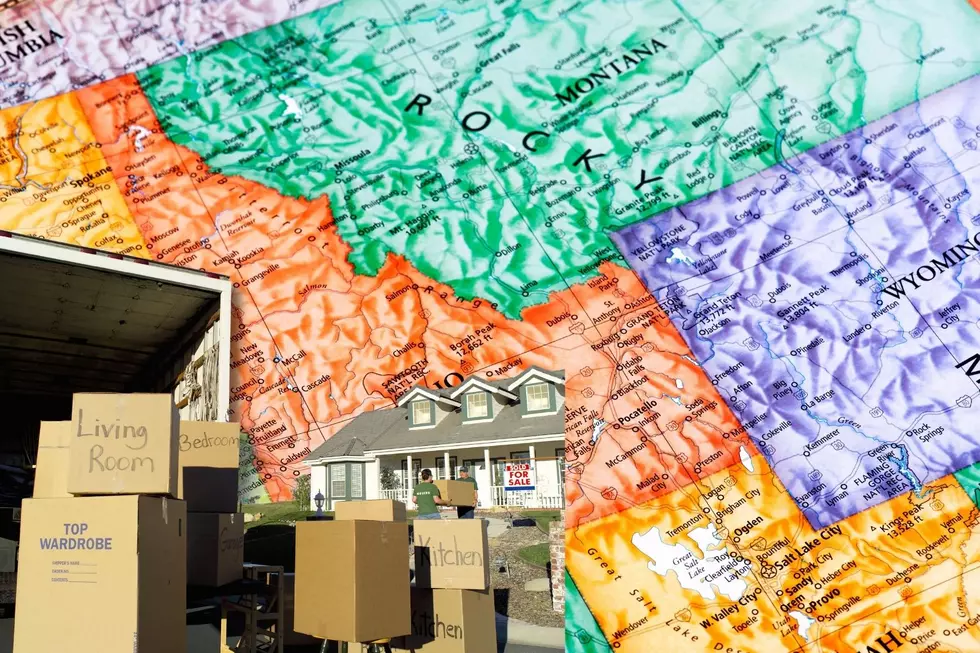
Nearly Half Of Americans Now Live Outside Their Birth State, New Data Shows
I wasn't born in Utah. That dubious honor goes to California. Please don't bring the tar and feathers. I turned tail from California in 1977 and have never looked back. Sure, I have some great memories from being a kid, youth and young adult down there, but I knew somewhere in my mid teens that I was bound to finish my days outside of my birth state. Apparently, I'm not alone.
Americans are increasingly willing to leave the state where they were born, and a new report from Gift Baskets on where Americans live and move offers an interesting look at what that could mean for Utah and the broader Mountain West.

Numbers Declining For People Living In States Where They Were Born
The report, released August 12, combines Census Bureau birthplace and migration data with moving activity from the first half of 2026. It finds that the percentage of Americans living in the state where they were born has declined from 59.1 percent in 2010 to 56.8 percent in 2024. In other words, nearly 43 percent of Americans now live somewhere other than their birth state.
And where people move may have as much to do with who is already there as it does with the destination itself.
The report found a strong relationship between established networks of people from one state and subsequent migration from that state. The correlation between the size of an existing state network and the number of people subsequently moving along that route was 0.89.

That is particularly interesting in the West, where several states are experiencing strong migration. Idaho and Arizona ranked second and third, respectively, on the report’s Mover Attraction Score, while Colorado and Nevada also ranked near the top.
Utah does not appear among the highest-ranked states on that particular measure, but its geographic position puts it squarely in the middle of one of the country’s most active population-shifting regions.
Arizona, for example, had a net migration rate of 8.37 people per thousand residents in 2023, and Arizona also had three ZIP codes make the report’s list of locations with rising moving activity in 2026.

For Southern Utah, those numbers are worth watching. St. George and Cedar City are part of a broader Western migration corridor connecting Utah with Arizona, Nevada, California, Idaho and Colorado. As more people establish roots in the Mountain West, those existing networks could potentially influence where the next wave of newcomers decides to settle.
Read More: Utah Is Still A Destination State
The report also offers an important caution. Its Mover Attraction Score is not a ranking of the best places to live. It does not consider housing costs, jobs, taxes, schools, safety or weather. Instead, it is designed to measure migration patterns and signs of mover interest.
Still, the larger trend is difficult to ignore. Americans are becoming less tied to their birthplaces, and the Mountain West is playing an important role in that reshuffling of the American population.

For Utah, the question may not simply be whether people are moving into the state. It may be how Utah fits into a rapidly changing Western neighborhood—and whether the people already here help determine who comes next.

And Idaho, if all that attraction is coming from California, Oregon and Washington I'd start being very concerned. Unless those folks fleeing Oregon and Washington are fleeing as refugees from their state governments. In that case they should be welcome.
LOOK: Where people in Utah are moving to most
Gallery Credit: Stacker
More From KSUB 590/107.3